One record
What is master data management? A plain guide for CFOs
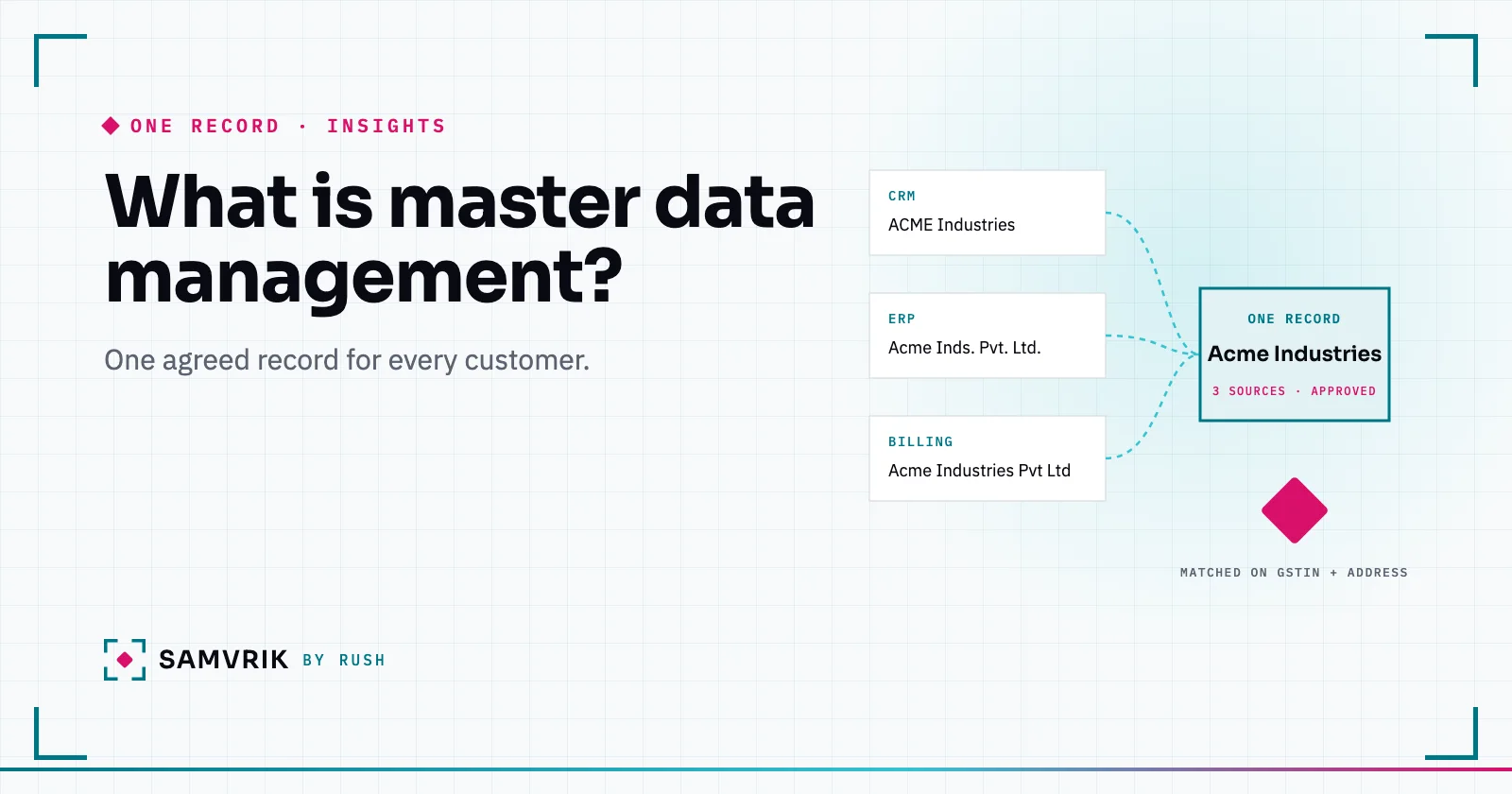
Master data management (MDM) means keeping one agreed version of each customer, supplier and product, so every system and every team uses the same one.
If finance, sales and operations each report a different revenue figure for the same customer, you do not have a reporting problem. You have a master data problem.
Master data vs everything else
Master data
The things your business deals with. Customers, suppliers, products, locations. Changes slowly. Used everywhere.
Transaction data
What happens to those things. Orders, invoices, payments, shipments. Changes every minute. Points back to master data.
Why the numbers disagree
Each system was set up by a different team, at a different time. So the same customer is typed three different ways. Reports add them up as three customers, or miss two of them.
These three rows are the same company. Press the button to match them.
How MDM works, in four steps
- Connect the systems that hold customers, suppliers or products.
- Match the records that are really the same thing, using rules like "same tax ID and same address".
- Check the unclear matches. A person approves them instead of guessing.
- Share the one agreed record back to every team and report.
How to start without a big project
- Pick one area. Customers is usually the right first choice.
- Pick one painful report. The one finance argues about every month.
- Agree the matching rules with the people who own the data.
- Keep history. Every merge should show what it came from, so auditors can follow it.
You do not need to move all your data into a new system first. Good MDM can read data where it already sits.
What counts as master data
Customers
Legal name, GSTIN, PAN, addresses, contacts, credit limits, parent company.
Suppliers
Legal name, bank details, tax IDs, certifications, payment terms.
Products
Codes, descriptions, HS codes, units, prices, cost.
Locations and people
Plants, warehouses, cost centres, employees and their roles.
A worked example: the month-end close
Finance closes the books. The sales report says one large customer bought more than the ledger shows. Someone spends two days in spreadsheets and finds the reason: the customer exists three times, under three spellings, and one of them is linked to a different branch.
With master data management, that customer exists once. Every order and invoice points to the same record. The sales report and the ledger agree, and the two days are saved every month.
How matching works
- Exact match on IDs. Same GSTIN or PAN means the same company. This is the strongest signal.
- Close match on names and addresses. "Acme Inds. Pvt. Ltd." and "Acme Industries Private Limited" are likely the same. Software scores how close they are.
- Rules decide what is automatic. A very strong match merges on its own. A weaker one waits for a person.
- History is kept. Every merge records which records it came from, so it can be undone.
Four ways companies run MDM
| Style | How it works | Good for |
|---|---|---|
| Registry | Links records across systems without changing them | A quick, light start |
| Consolidation | Builds one clean copy for reporting | Reports and analytics |
| Coexistence | Keeps one clean copy and sends fixes back to source systems | Most growing companies |
| Centralised | All changes happen in the MDM system first | Strict control, bigger change |
Who owns master data
Technology does the matching, but people decide what is right. Each domain needs:
- a data owner, a senior person who decides the rules (for customers, often the head of sales operations or finance),
- data stewards, who review unclear matches and fix errors day to day.
Signs you need MDM
- Teams argue about whose number is right.
- The same customer or supplier is set up again and again.
- Invoices go to old addresses, or payments to old bank accounts.
- Every new system or acquisition makes reporting harder.
Common mistakes
- Starting with every domain at once. Start with one.
- Buying a tool before agreeing the rules. The tool cannot decide what "one customer" means for you.
- Cleaning once and stopping. Without owners and rules, the duplicates come back.
Your first MDM project, step by step
- Choose the domain and the pain. For example: customers, because invoices go to the wrong address.
- List the sources. Every system that creates or changes customer records.
- Profile the data. Count duplicates, blanks and invalid IDs, so you know where you start.
- Agree the rules. What makes two records the same? Which source wins for which field?
- Match and review. Let strong matches merge, and have stewards review the rest.
- Publish the record. Point the painful report at the matched customers first.
- Stop new duplicates. Check new customers against the record before they are created.
How to measure progress
Pick a few measures before you start, record where you are, and report them monthly:
- the share of records with a valid tax ID,
- the number of suspected duplicates still waiting for review,
- how long it takes to set up a new customer,
- how many report disputes come up at month-end.
Why MDM matters even more with AI
AI tools answer questions from your data. If the same customer exists three times, the AI gives three partial answers, or adds them up wrongly, and sounds confident either way. Clean master data is one of the simplest ways to make AI answers trustworthy.
Key terms
- Golden record: the single, agreed version of an entity after matching.
- Survivorship: the rules for which source's value wins for each field.
- Data profiling: measuring the state of your data before you change it.
- Entity resolution: working out which records refer to the same real thing.
Where Samvrik fits
Smelter is Samvrik's record layer. It reads your systems where they are, matches records, holds unclear matches for a person, and gives every team the same number. It runs inside your own environment, and every value shows where it came from.
Common questions
What is master data management in simple terms?
Keeping one agreed version of each customer, supplier and product, shared by every system and team.
What is the difference between master data and transaction data?
Master data describes the things you deal with, such as customers. Transaction data records what happens to them, such as orders and invoices.
Do we need to move all our data for MDM?
No. Good MDM can read data where it already sits and publish one agreed record.
What is a data steward?
The person who reviews unclear matches and fixes master data errors day to day, within the rules set by the data owner.
Which master data should we start with?
Usually customers, because customer errors affect sales, finance and service at the same time.