Act on outside data
Landed cost: the formula, a calculator, and why tariff changes break it
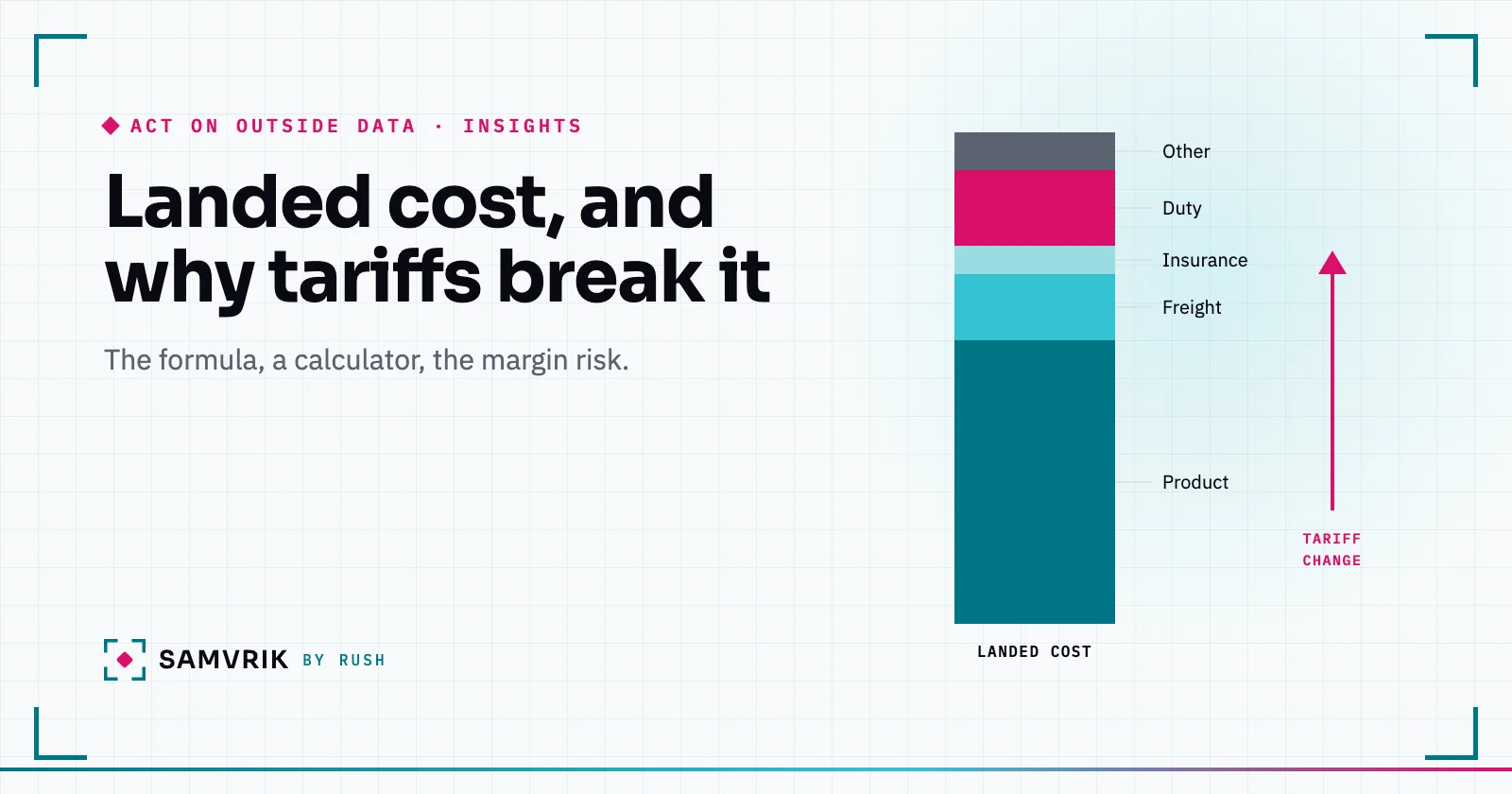
Landed cost is everything you pay to get a product to your door: the product, freight, insurance, duties and other charges. Price on anything less and you lose margin.
The supplier's price is only the start. By the time goods reach your warehouse, you have paid for shipping, insurance, customs duty and handling. Landed cost adds all of it up.
The formula
Customs duty is usually worked out on the first three added together (cost, insurance and freight). So when freight goes up, the duty you pay goes up too.
Try it with your own numbers
The numbers below are an example only. Replace them with your own.
Why tariff changes break it
Most companies work out landed cost once, put it in a spreadsheet, and set prices from it. Then a duty rate changes. The spreadsheet does not know. Quotes keep going out on the old cost, and the margin disappears quietly.
Tariffs change more than people expect. The US tariff schedule, for example, was revised 32 times in 2025.
A note on India
For imports into India, the duty usually includes Basic Customs Duty, a Social Welfare Surcharge and IGST. IGST can often be claimed back as input tax credit, so many companies leave it out of landed cost. Check the exact rates for your product's HS code with your customs broker.
How to keep landed cost right
- Store duty rates by HS code in one place, not in each spreadsheet.
- Watch the official source for changes.
- When a rate changes, find every product, order and quote it touches.
- Recalculate, and send any price change to the right person to approve.
A worked example, step by step
These are the example numbers from the calculator above. They are for illustration only.
| Step | Working | Amount |
|---|---|---|
| 1. Product cost | What the supplier charges | ₹10,00,000 |
| 2. Freight | Getting it to India | ₹80,000 |
| 3. Insurance | Covering the trip | ₹10,000 |
| 4. Value for duty | 1 + 2 + 3 | ₹10,90,000 |
| 5. Duty at 10% | 10% of step 4 | ₹1,09,000 |
| 6. Other charges | Port, handling, clearing | ₹25,000 |
| Landed cost | 4 + 5 + 6 | ₹12,24,000 |
| Per unit | ÷ 1,000 units | ₹1,224 |
If your selling price was set when each unit cost ₹1,224, that ₹109 comes straight out of your margin on every unit.
Who pays what: Incoterms
The shipping terms in your contract decide which costs are already in the supplier's price. The three you will see most:
- FOB (Free on Board): the supplier pays until the goods are loaded at their port. You pay freight, insurance, duty and everything after.
- CIF (Cost, Insurance and Freight): the supplier pays freight and insurance to your port. You pay duty and everything after.
- DDP (Delivered Duty Paid): the supplier pays everything, including duty. Their price is close to your landed cost.
Comparing an FOB quote with a DDP quote without adjusting is one of the most common pricing errors in importing.
Costs people forget
- Currency movement between order and payment.
- Bank charges on foreign payments.
- Demurrage and detention when containers wait at the port.
- Inland transport from the port to your warehouse.
- Customs broker and inspection fees.
- Warehousing while goods wait to be sold.
India customs in a little more detail
- Assessable value is the transaction value, normally including freight and insurance. Duty is worked out on this.
- Basic Customs Duty (BCD) is a percentage of the assessable value, set by the product's tariff line.
- Social Welfare Surcharge is usually 10% of the BCD.
- IGST is charged on the assessable value plus BCD plus surcharge. It can usually be claimed back as input tax credit.
- HS codes classify every product. India uses 8-digit codes. A wrong code means a wrong duty.
Rates change through official notifications. Check the current rate for your exact code before you price.
How often to recalculate
Recalculate whenever an input changes: a new duty rate, a new freight contract, a big currency move or a new supplier. The difficulty is not the maths. It is knowing that something changed, and which products it touches.
From landed cost to a selling price
Landed cost tells you what a unit really costs. Your price has to cover it and leave the margin you need. Using the example numbers again (illustration only):
- Landed cost per unit: ₹1,224.
- Target margin: 25% of the selling price.
- Selling price = landed cost ÷ (1 − margin) = 1,224 ÷ 0.75 = ₹1,632.
Now the duty rises to 20%, and landed cost becomes ₹1,333. If the price stays at ₹1,632, the margin falls to about 18%. Nobody decided to cut the margin. It happened because the price list did not know the cost had changed.
Set a margin floor
A simple rule protects you: if margin on any product falls below a set level, a person must approve the price. That one rule turns a silent loss into a visible decision. Our guide to the business rules engine shows how such a rule works.
Track it per product, not per shipment
A shipment often carries many products. Freight, insurance and charges need to be split across them, usually by value, weight or volume. Choose one method, write it down, and use it every time, so product costs can be compared month to month.
Who should own landed cost
Usually finance, with input from procurement and logistics. Finance owns the method, procurement owns supplier prices and terms, and logistics owns freight and charges. When nobody owns it, each team keeps its own spreadsheet, and you are back to three numbers.
Where Samvrik fits
This is exactly the job Samvrik was built for. Quarry picks up the tariff change at the official source. Smelter finds every supplier, order and quote it touches. Assembler recalculates landed cost and sends the price change to finance for one approval. All of it is logged.
Source for the US example: US International Trade Commission, Harmonized Tariff Schedule 2025 (Basic Edition plus Revisions 1 to 32).
Common questions
What is the landed cost formula?
Landed cost = product cost + freight + insurance + duties + other charges.
Is customs duty calculated on the product cost alone?
Usually not. Duty is normally calculated on cost, insurance and freight together.
Should IGST be included in landed cost in India?
IGST on imports can often be claimed back as input tax credit, so many companies leave it out. Check with your customs broker.
What is the difference between FOB and CIF?
Under FOB you pay freight and insurance from the supplier's port. Under CIF the supplier pays them up to your port.
Why does the HS code matter for landed cost?
The HS code decides the duty rate. A wrong code means a wrong duty, and a wrong landed cost.