One record
Data governance tools: how to choose one
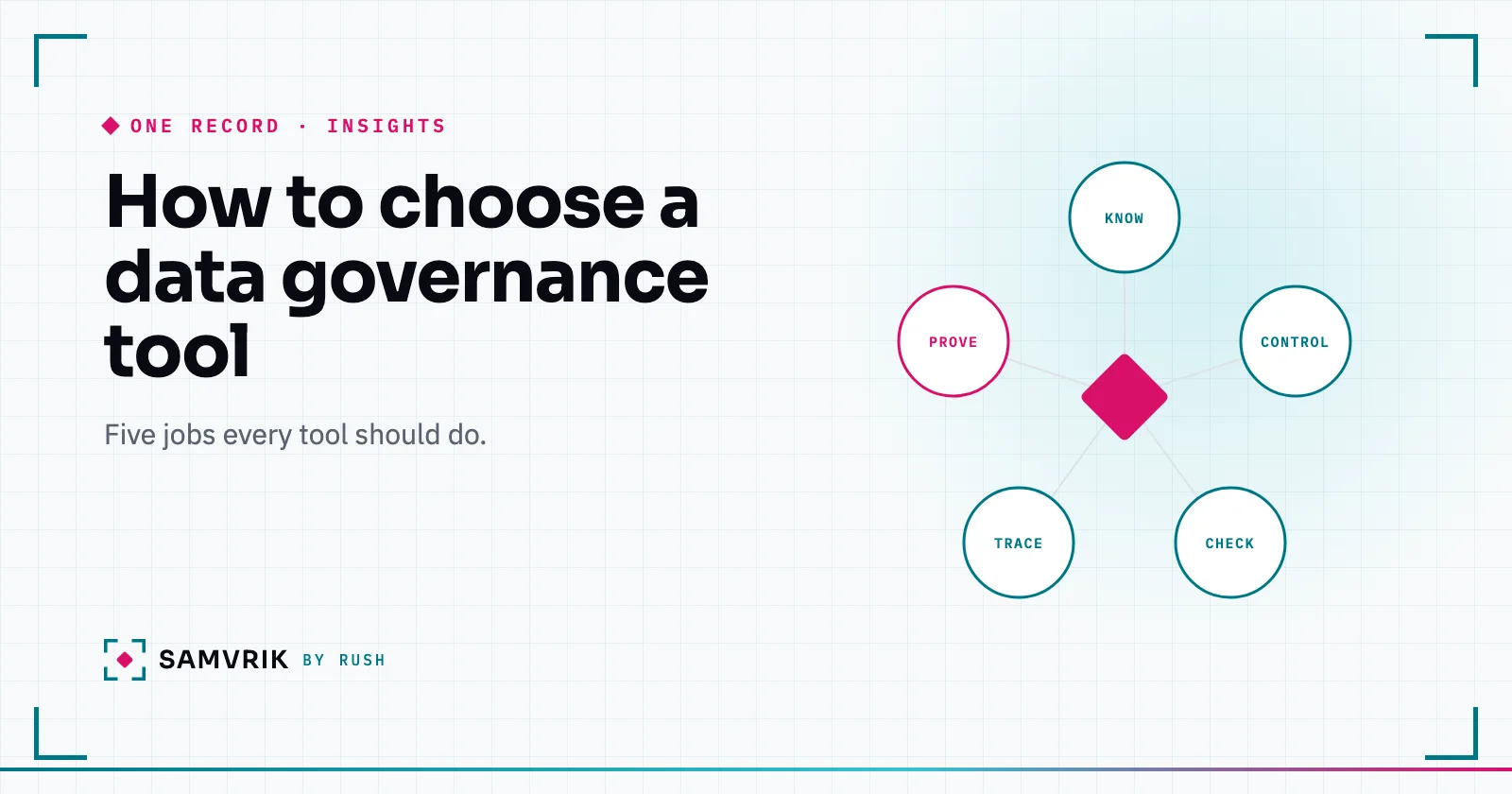
A data governance tool helps you know what data you have, control who sees it, check its quality, trace where it came from, and prove all of that. Choose by the jobs you need, not the feature list.
"Data governance" sounds like paperwork. In practice it answers simple questions. What data do we have? Can we trust it? Who is allowed to see it? Can we prove that?
The five jobs of a governance tool
Quick check: what do you need?
Answer five questions. Your list of must-have features updates as you go.
Six questions to ask every vendor
- Where does our data go? Can the tool run fully inside our environment?
- Do we have to copy data into your tool, or can it read data where it sits?
- Can you control access down to the row and the column?
- What happens when data fails a quality rule? Is it held, or just flagged?
- Can we see where every number came from, all the way to the source?
- If we leave, what format is our data in?
Common mistakes
- Buying a catalog and calling it governance. Knowing what data exists does not stop bad data spreading.
- Starting with all data. Start with one area and one report people argue about.
- No owner. Every important dataset needs a named person who approves changes.
The people behind governance
Tools support governance. People run it. Three roles matter:
- Data owner: a senior person who decides who can use a dataset and what "good" means for it.
- Data steward: handles quality issues and questions day to day.
- Data custodian: usually IT. Runs the systems, backups and security.
If nobody holds these roles, even the best tool turns into an unused catalog.
The kinds of tools on the market
| Type | Main job | Open-source examples |
|---|---|---|
| Data catalog | Know what data exists | DataHub, OpenMetadata, Apache Atlas |
| Data quality | Check data against rules | Great Expectations, Soda Core |
| Access control | Control who sees what | Apache Ranger |
| Lineage | Trace where data came from | OpenLineage |
| All-in-one platform | Several of the above together | Varies |
How to run a fair evaluation
- Pick one real dataset people care about, such as customer master or monthly revenue.
- Write your must-haves first, using the tool-fit check above.
- Ask each vendor for a proof of concept on that dataset, in your environment.
- Score what you saw, not what the slides promised.
- Ask the people who will use it daily: the stewards, not only the buyers.
The full cost to plan for
- Licences, or support for open-source tools.
- Servers or cloud capacity to run it.
- People: owners, stewards and engineers.
- Connecting it to your systems.
- Training, so teams actually use it.
The licence is often the smallest part. The people and the connections take most of the effort.
What the first 90 days should look like
- Name owners for your three most important datasets.
- Write five to ten quality rules for each one.
- Turn on access control and logging for them.
- Show one report that now comes from governed data, and say so on the report.
A small visible win builds the support you need for the rest.
Red flags in a vendor demo
- Only sample data. Ask to see it on your data, in your environment.
- "It is all automatic." Matching and quality always need people to decide unclear cases.
- Data must be copied to their cloud. Check whether that fits your rules on where data can go.
- No export path. If you cannot get your data and metadata out easily, you are locked in.
- Logs you cannot query. Ask them to find one specific change from last month, live.
Governance for DPDP and AI
Two new pressures make governance urgent. India's DPDP law asks you to know where personal data sits, protect it and prove it. AI tools need trusted, well-described data to give reliable answers. A governance tool that tags personal data, controls access and logs use helps with both at once.
How to know it is working
- More important datasets have a named owner.
- Quality rules catch problems before reports do.
- People find data through the catalog instead of asking around.
- Access requests are approved and logged, not granted by email.
Key terms
- Metadata: data about data, such as its owner, meaning and source.
- Lineage: the path data took from its source to a report.
- Masking: hiding sensitive values, such as showing only the last four digits.
- Data contract: an agreement on the shape, quality and freshness of a dataset between those who produce it and those who use it.
Where Samvrik fits
Smelter covers all five jobs in one place, inside your own environment. It reads data where it sits, holds bad data for a person, controls access down to the row, traces every value to its source and logs every action. It uses open table formats, so you are never locked in.
Common questions
What does a data governance tool do?
It helps you know what data you have, control who sees it, check its quality, trace where it came from, and prove all of that.
Is a data catalog the same as data governance?
No. A catalog tells you what data exists. Governance also controls access, checks quality and records every action.
Can data governance tools run on-premise?
Some can. If your data must stay inside your environment, ask each vendor whether the tool runs fully on your own servers.
Are there open-source data governance tools?
Yes. Examples include DataHub and OpenMetadata for catalogs, Great Expectations and Soda Core for quality, and Apache Ranger for access control.
Who should own data governance?
A senior data owner for each important dataset, supported by data stewards. IT runs the systems, but should not own the decisions alone.