One record
Single source of truth: what it means, and how to get one without moving your data
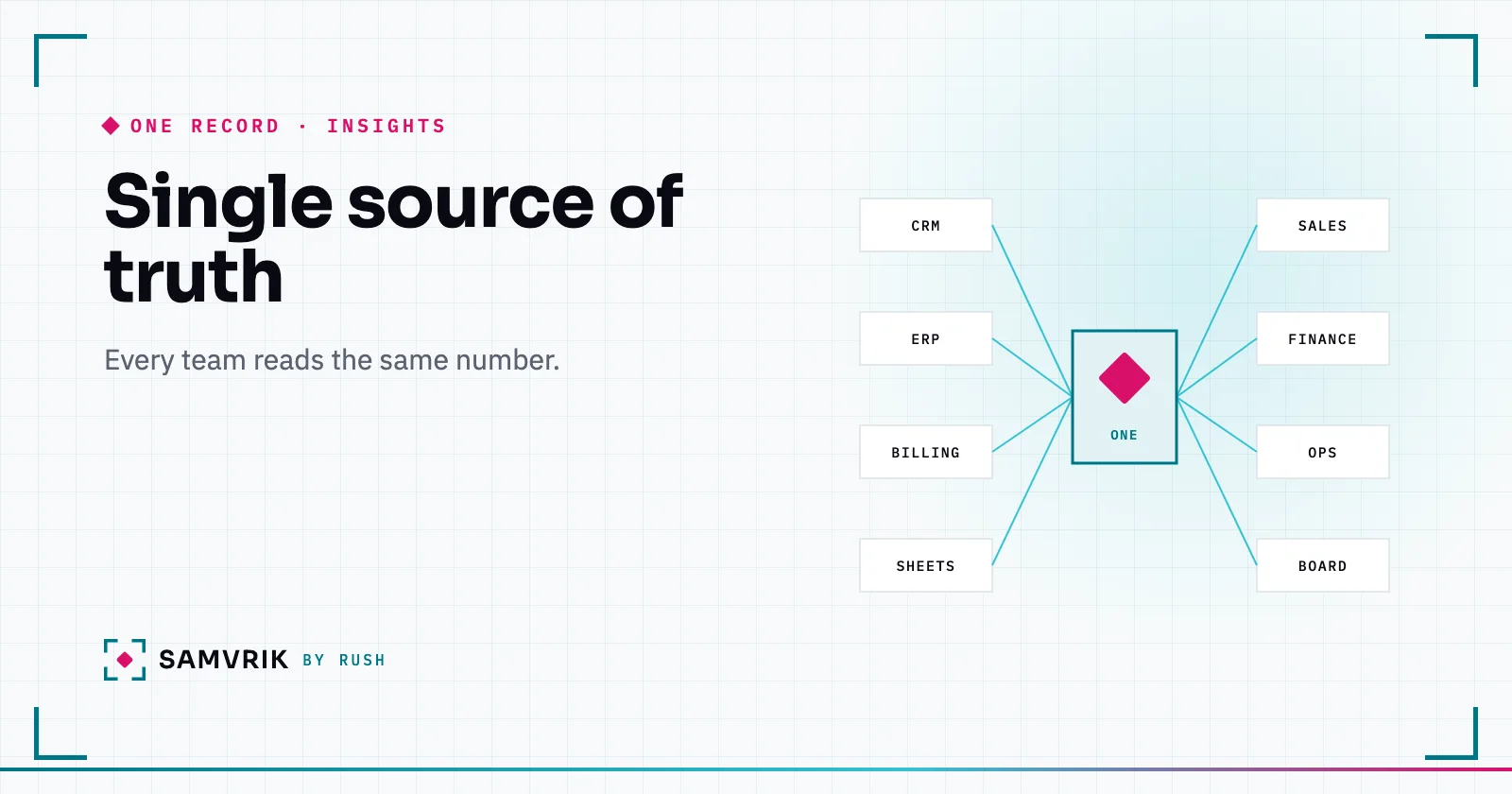
A single source of truth means every team reads the same agreed number from the same place. You get one by agreeing definitions and matching records across systems, not by moving everything into one database.
Ask sales, finance and operations for last month's revenue. If you get three different numbers, you do not have a single source of truth. Each team is right by its own rules, and the meeting turns into an argument about whose spreadsheet wins.
Why the numbers disagree
All three figures below describe the same month. Press the button to see why they differ.
- Different definitions. Sales counts a deal when it is signed. Finance counts it when it is invoiced. Operations counts it when it ships.
- Different customer lists. The same customer is spelled three ways, so some orders are counted twice and some are missed.
- Different timing. Each report was pulled on a different day.
None of these is a mistake on its own. The problem is that nobody agreed which number the company uses, and the systems do not share one list of customers.
What a single source of truth looks like
How to get one, in five steps
- Pick the number people argue about. Usually revenue, margin or customer count.
- Write the definition down. "Revenue means invoiced value, net of credit notes, in INR."
- Match the records. Make sure each customer and product appears once, across every system.
- Show where each value came from. So anyone can check a number back to its source.
- Make it the only place reports read from. Then retire the side spreadsheets.
You do not need a big migration
Many companies think a single source of truth means moving everything into one new system. That takes years and often fails. A better way is to leave data where it is, read it in place, match it, and publish one agreed version. This is what master data management does for customers, suppliers and products.
Start with definitions
Most "which number is right" fights are really about definitions. Here is how one word can mean three things.
| Team | "Revenue" means | Counted when |
|---|---|---|
| Sales | Bookings | The deal is signed |
| Finance | Invoiced revenue | The invoice is raised |
| Operations | Fulfilled orders | The goods ship |
Write each definition down in one sentence, give it an owner, and publish it where everyone can read it. This list is often called a business glossary.
Single source of truth vs single version of truth
- Single source of truth is about where data lives: each piece of data is mastered in one place.
- Single version of truth is about what people agree: one agreed number for each measure.
You need both. One source with no agreed definitions still produces arguments. Agreed definitions with five sources still produce different numbers.
How to keep it true over time
- Change control: a definition only changes when its owner approves, and the change is recorded.
- Quality checks: rules that catch bad data before it reaches reports.
- One door for reports: dashboards and board packs read only from the agreed record.
- Retire the side copies: each spreadsheet that survives is a future second truth.
Signs it is working
- Meetings discuss what the number means, not which number is right.
- Month-end close gets shorter.
- Anyone can click a number and see where it came from.
- New reports take days, not weeks.
Common objections, answered
- "Our ERP is already the source of truth." For transactions, perhaps. But customers, products and targets usually live in several systems too.
- "We tried a data warehouse and it did not help." A warehouse stores data. Without matched records and agreed definitions it stores the disagreements too.
- "It will take years." Not if you start with one number and one domain.
A worked example: counting customers
The board asks a simple question: how many active customers do we have? Sales says one figure, finance another, support a third. Here is how one company could settle it:
- Define "active". The CFO decides: a customer with an invoice in the last 12 months.
- Match the customers. Duplicates across CRM, ERP and billing are merged into one record each.
- Count once. The number is calculated from the one record, using the one definition.
- Show the working. Anyone can see which customers are in the count, and why.
- Lock the definition. It only changes with the CFO's approval, and the change is logged.
Next quarter, nobody asks which number is right. They ask why it moved.
Why AI makes this more urgent
If you connect an AI assistant to your data, it will use whatever it finds. With three customer lists and no agreed definitions, it can give a different answer each time it is asked. A single source of truth gives AI one record and one meaning to work from.
A quick self-check
- Does each key number have a written definition and an owner?
- Does each customer and product exist once across your systems?
- Can you trace any reported number back to its source records?
- Do reports read from one place, or from many spreadsheets?
Three or more "no" answers means the source of truth is still the person who builds the spreadsheet.
Where Samvrik fits
Smelter reads your systems where they sit, matches records, holds unclear matches for a person to approve, and publishes one record that every team reads. Each number shows where it came from. It runs inside your own environment. See how Smelter works.
Common questions
What does single source of truth mean?
Every team reads the same agreed number from the same place.
Why do different teams report different numbers?
Usually because of different definitions, different customer lists and data pulled at different times.
Do we need one big database for a single source of truth?
No. You can leave data where it is, match it, and publish one agreed version.
What is the difference between a single source of truth and a single version of truth?
A single source of truth is where data is mastered. A single version of truth is the one agreed number people use. You need both.
What is a business glossary?
A shared list of definitions for key terms like revenue or active customer, each with an owner.